
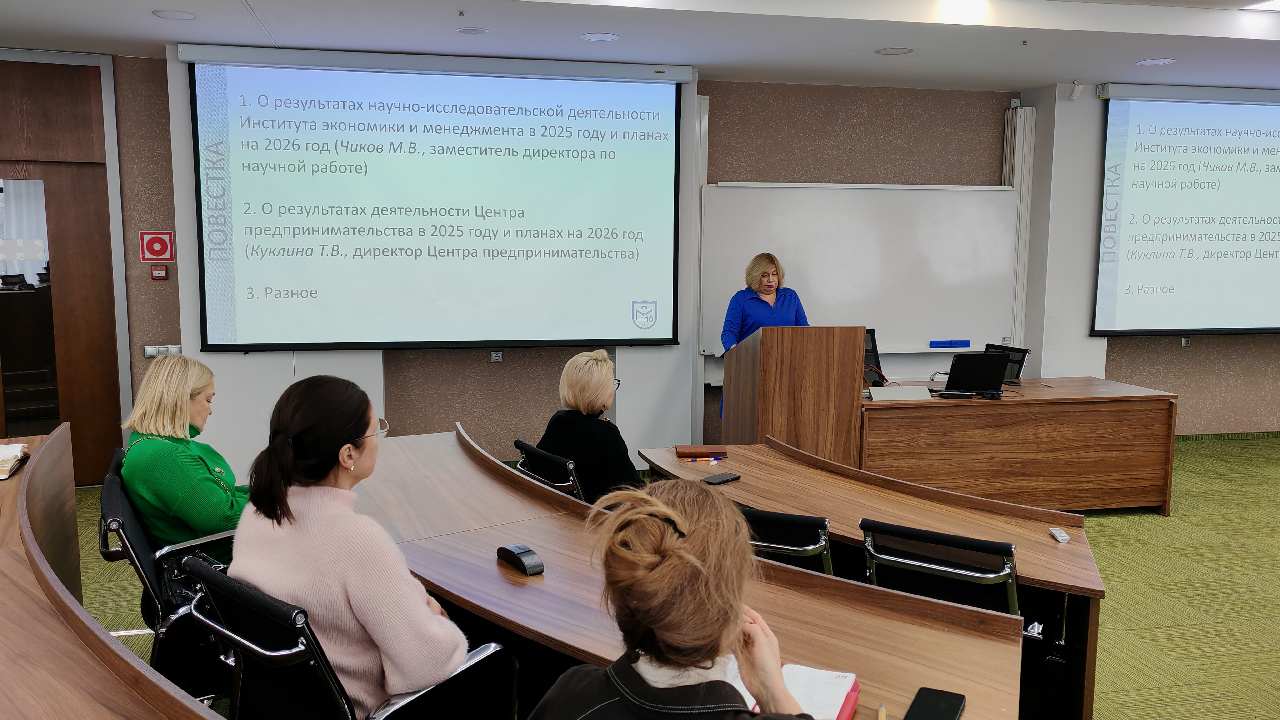
At the Meeting of the IEM Academic Council on January 29, 2026
At the first meeting of the IEM TSU Academic Council in 2026, a review of key achievements and plans for 2026 in the field of scientific activity and the development of technological entrepreneurship was presented. In addition, the meeting marked the beginning of an anniversary year for the institute: in February, IEM will celebrate the 105th anniversary of Professor Alexander Bychkov (1921–2009), and in May, the 10th anniversary of the founding of the Institute of Economics and Management at TSU will be celebrated.
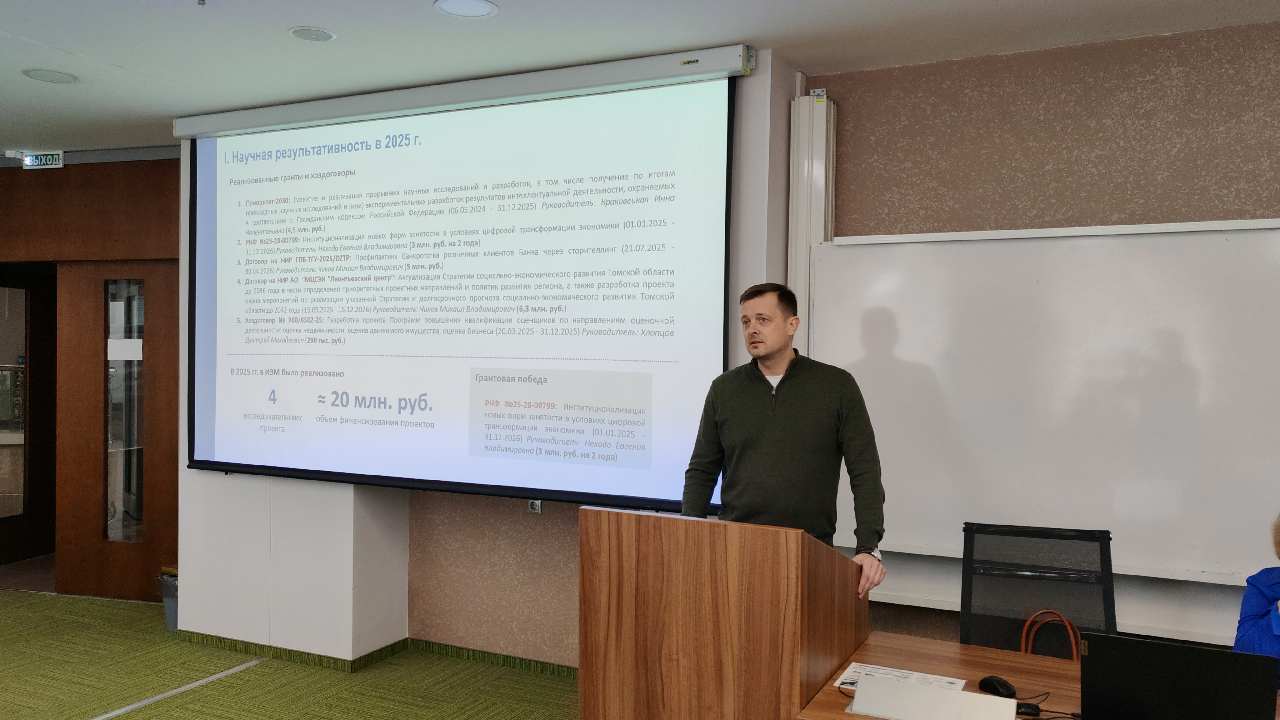
The report by Mikhail Chikov, Deputy Director of IEM for Research, consisted of three key points reflecting the institute's scientific activities and prospects for their development. The scientific performance over the past period was reviewed, and scientific events planned for the upcoming year were presented. In conclusion, council members discussed development plans in the field of science in order to further outline strategic guidelines in this area.
Mikhail Vladimirovich noted the growth in research funding volumes in 2025 as one of the most important indicators.
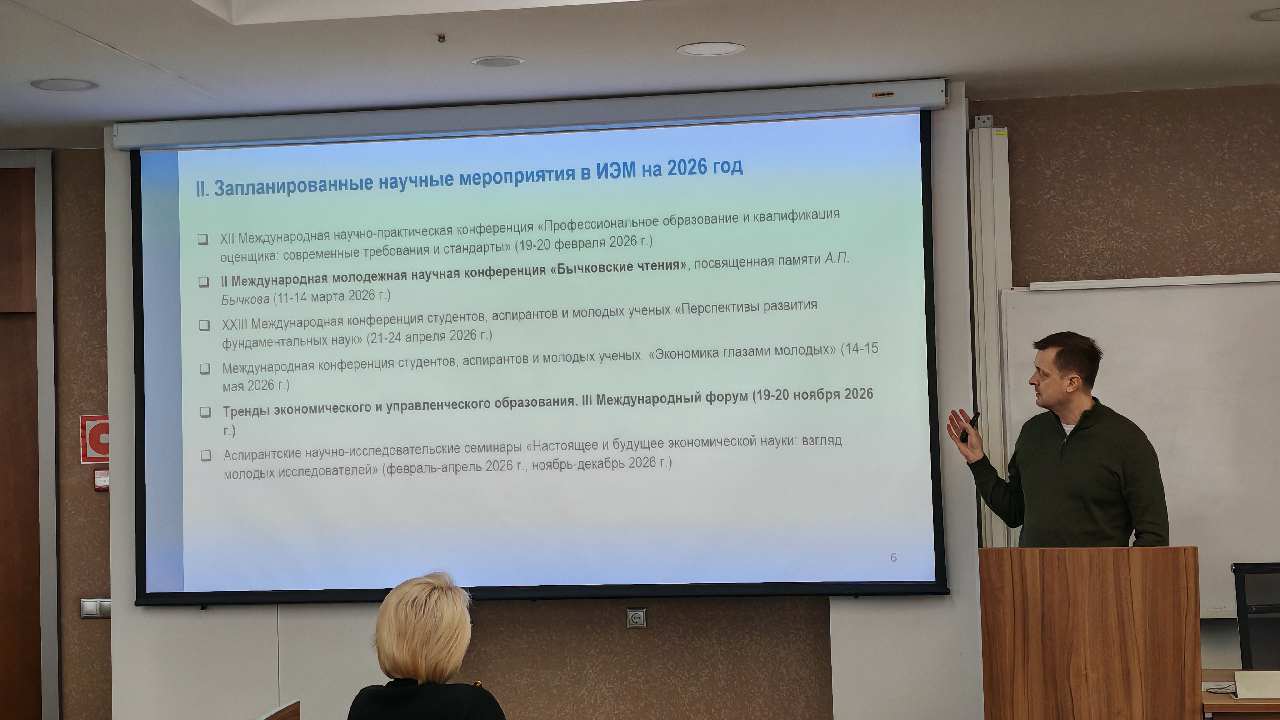
Regarding scientific events: among the new events were the first "Bychkov Readings," which gathered more than a hundred participants, including those from other cities. The traditional conference "Economic Readings" was held at a high international level, confirming its status with the participation of colleagues from various countries. Mikhail Vladimirovich particularly noted the importance of making postgraduate seminars regular—they are held at least once per semester, with the next one (for English-speaking postgraduate students) scheduled for February.
Several significant scientific events are planned for 2026: the second "Bychkov Readings" will take place in March, the international forum "Trends in Economic and Law Enforcement Education" will traditionally be organized in the fall. Postgraduate seminars will continue, ensuring regular support and development for our postgraduate students.
Among the serious problems in IEM's scientific activities requiring solutions, Mikhail Chikov named the insufficient involvement of students in scientific work.
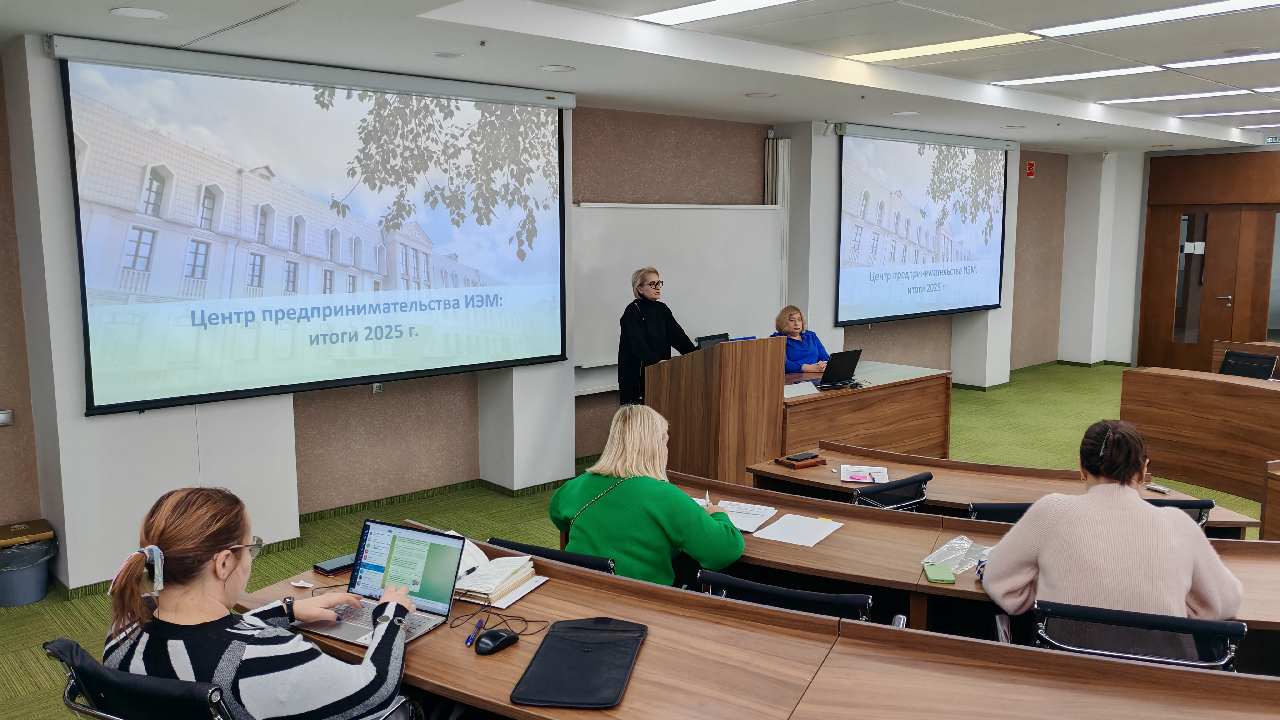
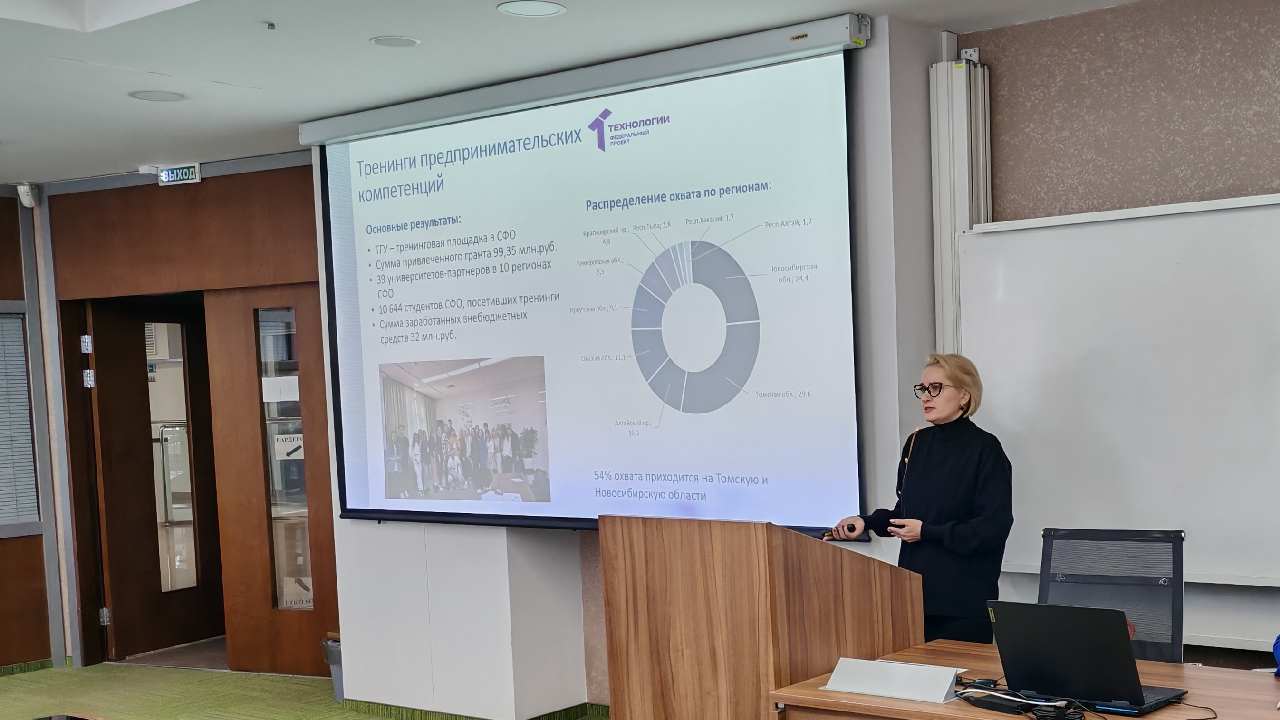
Tatiana Kuklina reported on the results of the activities of the TSU Entrepreneurship Center. She noted that the center's activities are becoming increasingly complex due to tightening requirements for grant funds.
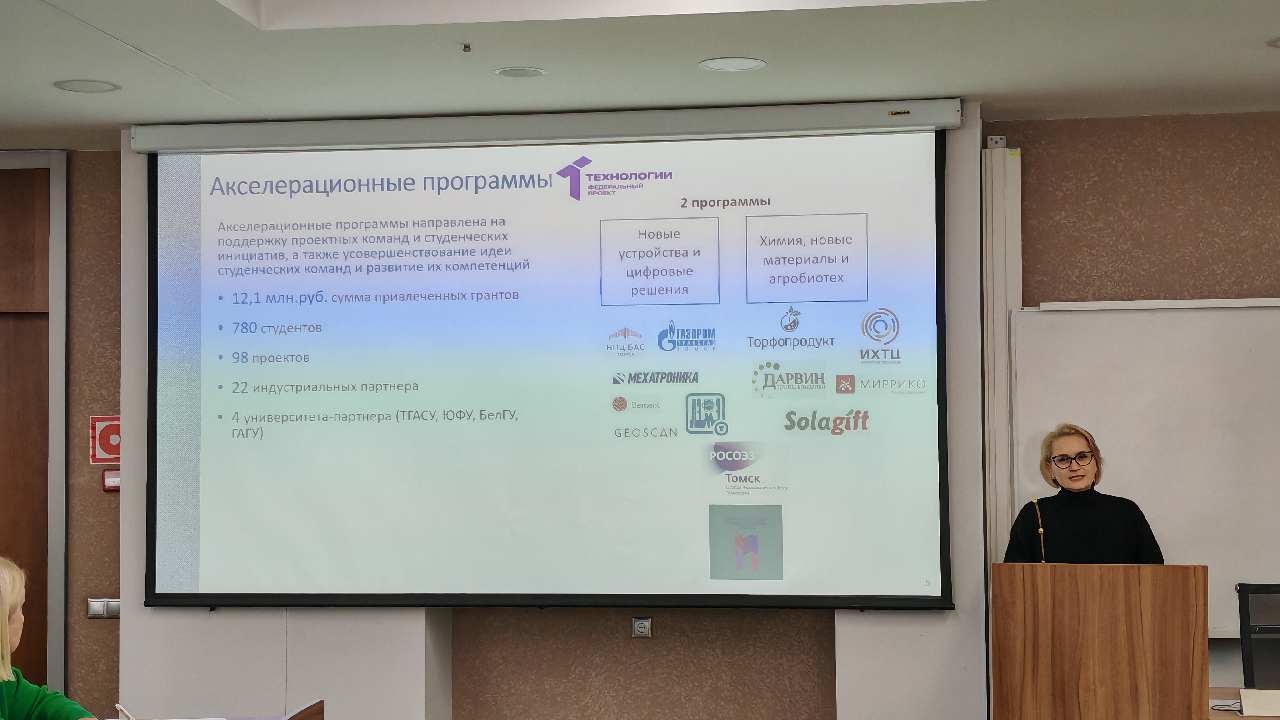
The activities of the Entrepreneurship Center include, among other things, implementing an entrepreneurship course at 12 TSU faculties, covering more than 900 students annually. In 2025, a professional retraining program "Development and Organization of a Startup" was launched for participants in accelerator programs. Additionally, the TSU Entrepreneurship Center is a competency center for the "Captains" program with 10 partner universities. Work continues within the framework of the federal project "Technologies" (formerly the "Platform for University Technological Entrepreneurship"), including conducting trainings, accelerator programs, and assisting students in obtaining grants.
The report by Mikhail Chikov, Deputy Director of IEM for Research, consisted of three key points reflecting the institute's scientific activities and prospects for their development. The scientific performance over the past period was reviewed, and scientific events planned for the upcoming year were presented. In conclusion, council members discussed development plans in the field of science in order to further outline strategic guidelines in this area.
Mikhail Vladimirovich noted the growth in research funding volumes in 2025 as one of the most important indicators.
"Two major research contracts were concluded in which our staff actively participate. Within the framework of the 'Priority-2030' program, the project by Inna Valentinovna Krakovetskaya on developing a conceptual model and criteria for assessing the sustainable competitiveness of regions continued. A two-year RSF project led by Evgenia Vladimirovna Nekhoda, 'Institutionalization of New Forms of Employment in the Context of Digital Transformation of the Economy,' is being implemented. And the most significant for us today is the project to update the strategy for the socio-economic development of Tomsk Oblast, which brought in more than 20 million rubles and gave us valuable experience," said Mikhail Chikov.
Regarding scientific events: among the new events were the first "Bychkov Readings," which gathered more than a hundred participants, including those from other cities. The traditional conference "Economic Readings" was held at a high international level, confirming its status with the participation of colleagues from various countries. Mikhail Vladimirovich particularly noted the importance of making postgraduate seminars regular—they are held at least once per semester, with the next one (for English-speaking postgraduate students) scheduled for February.
Several significant scientific events are planned for 2026: the second "Bychkov Readings" will take place in March, the international forum "Trends in Economic and Law Enforcement Education" will traditionally be organized in the fall. Postgraduate seminars will continue, ensuring regular support and development for our postgraduate students.
Among the serious problems in IEM's scientific activities requiring solutions, Mikhail Chikov named the insufficient involvement of students in scientific work.
"We propose reformatting the research seminars in the curricula of bachelor's and master's students: developing a unified concept and logic for these seminars across different years so that they are interconnected. This will allow us to ensure the consistent development of research competencies in students. As an additional solution, we are considering the possibility of creating an elective research module for students interested in science. We also consider it important to focus on supporting those scientific directions that have the potential to become full-fledged scientific schools, for example, in the field of labor markets or behavioral economics," noted the Deputy Director of IEM for Research.
Tatiana Kuklina reported on the results of the activities of the TSU Entrepreneurship Center. She noted that the center's activities are becoming increasingly complex due to tightening requirements for grant funds.
"In 2025, we won a grant to implement two accelerators, but many universities that previously received such support were unable to do so. The federal operator emphasizes that obtaining grants will become increasingly difficult, which requires improving the quality of projects. We are adapting to these changes, focusing on quality and innovation," noted Tatiana Valerievna.
The activities of the Entrepreneurship Center include, among other things, implementing an entrepreneurship course at 12 TSU faculties, covering more than 900 students annually. In 2025, a professional retraining program "Development and Organization of a Startup" was launched for participants in accelerator programs. Additionally, the TSU Entrepreneurship Center is a competency center for the "Captains" program with 10 partner universities. Work continues within the framework of the federal project "Technologies" (formerly the "Platform for University Technological Entrepreneurship"), including conducting trainings, accelerator programs, and assisting students in obtaining grants.
"In 2025, as a training platform, we taught 9,935 students from the Siberian Federal District, significantly increased the number of partner universities (currently there are 39; in 2026 we plan to have 40). We also attracted extra-budgetary funds by accrediting our training program and training about 6,000 students in other federal districts. In 2025, we launched two accelerator programs – 'Chemistry and New Materials' and 'New Devices and Digital Solutions.' Our students attracted 35 million rubles in 'Student Startup' grants. We implemented a series of consultations for winners to help them in running their businesses. We also formed a large pool of partner universities, which led to the creation of a consortium of universities in the Siberian Federal District in December 2025. This consortium is aimed at the joint development of technological entrepreneurship," said the Director of the TSU Entrepreneurship Center.